
Introduction
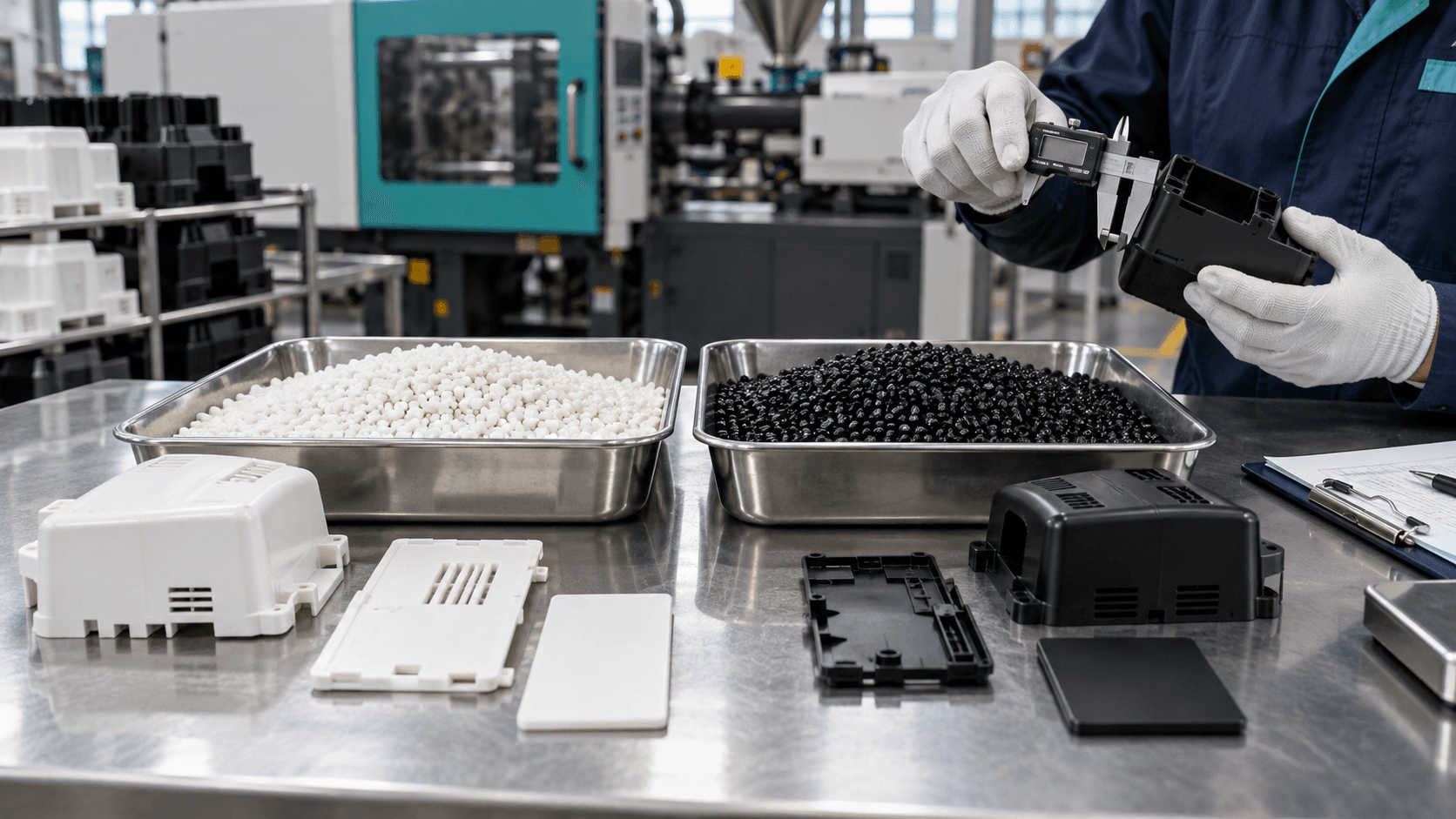
White and black recycled HIPS pellets can both work in injection moulding, but they do not create the same purchasing risk or the same processing flexibility. The right choice depends on the finished part, colour standard, cosmetic surface, expected impact exposure, use of masterbatch, moulding conditions and the buyer’s tolerance for lot-to-lot appearance variation.
The practical answer is simple: choose white recycled HIPS when the product needs a light or custom colour and the base material must provide reasonable colour latitude; choose black recycled HIPS when the finished component is black or very dark and robust coverage is more important than light-colour flexibility. That answer is only a starting point. Flow, toughness, contamination control, odour, surface quality and batch consistency still need to be validated.
At Cherein, white and black HIPS are positioned as injection grades for housings, racks, appliance components and industrial parts. Current website references show overlapping but different melt-flow and impact ranges. Those figures are grade references rather than universal design values. Buyers should request the current TDS and batch COA, confirm the test method and run their own mould and part validation.
This guide compares the two colour routes from a procurement and production perspective. It also explains how to plan a factory test, what to inspect after moulding and how to avoid choosing a grade only because its pellet colour looks attractive.
Quick Answer: White or Black Recycled HIPS?
White recycled HIPS is usually the more flexible base for white, pastel, bright or customer-specific colours. Black recycled HIPS is normally the more practical option for black housings, internal parts and products where a deep dark appearance can absorb normal feedstock colour variation. Neither colour automatically offers better mechanical performance; performance must be checked by grade, batch and finished part.
| Decision factor | White recycled HIPS | Black recycled HIPS |
|---|---|---|
| Typical colour objective | White, light, pastel or custom shades | Black and very dark shades |
| Colour correction flexibility | Higher, but base-colour consistency matters | Lower need for correction when black is acceptable |
| Visibility of specks or contamination | Defects can be more visible | Some visual variation may be less obvious, but contamination is not made harmless |
| Masterbatch demand | May require white or colour masterbatch to reach target | May require black masterbatch only for shade or coverage adjustment |
| Common application direction | Visible light-colour housings and components | Black housings, racks, internal parts and dark industrial components |
| Approval focus | Whiteness, yellow tone, specks, colour difference, odour | Depth of black, gloss, dispersion, plate-out, odour |
Start With the Finished Product Requirement
A pellet sample is easy to compare; a finished part is where the real decision is made. Before asking which HIPS colour is “better,” define what the customer will see and what the component must do.
Classify the visual requirement
Put the part into one of four categories:
- Hidden internal component. Colour may have a wide tolerance, while toughness, dimensions and assembly dominate.
- Visible industrial component. Surface consistency and an agreed commercial colour matter, but a premium decorative finish may not be necessary.
- Appearance-critical consumer surface. Colour difference, gloss, flow marks, specks and odour need tighter acceptance criteria.
- Regulated or safety-related component. Material approval must also address application-specific compliance and risk; pellet colour alone is irrelevant.
Black recycled HIPS often fits the first two categories well when black is allowed. White recycled HIPS may be necessary for light-colour products, but its feedstock selection and colour-control demands are usually higher. A buyer should not ask a white recycled grade to perform like a colourless virgin resin unless the supplier has provided evidence and the application trial confirms it.
Define colour with a physical reference
Words such as “white,” “ivory,” “deep black” or “customer black” are not complete specifications. Send an approved plaque, finished part or quantified colour target where available. Agree the viewing condition, surface texture and measurement method. The same formulation can look different on a polished plaque, a textured housing and a foamed or ribbed component.
For international orders, keep one approved master sample with the buyer and one with the supplier. Photographing a sample is useful for communication but should not replace the physical reference because camera settings, screens and lighting change perceived colour.
Compare Material Properties Under the Same Conditions
Colour should not hide a poor technical comparison. White and black recycled HIPS grades must be evaluated using comparable test conditions and representative batches.
Melt flow must be tied to the mould
Melt flow rate helps indicate whether a material is in the processing range needed for a mould, but it does not predict impact strength, shrinkage or surface quality by itself. ISO 1133-1 specifies procedures for determining MFR and MVR under stated temperature and load conditions. ASTM D1238 also emphasizes that melt-flow data are useful for quality control and process uniformity, while warning that flow rate is not a complete measure of other properties.
Cherein’s current website references list an MFI range of 5–8 for White Recycled HIPS and 4–7 for Black Recycled HIPS. Before comparing those numbers, obtain the complete test condition and current COA. A value reported at a different temperature or load cannot be treated as equivalent.
During a trial, record fill pressure, screw recovery, cushion, cycle time, part weight and any change in temperature. If one colour grade needs a substantially different process window, evaluate whether the factory can control that setting through a normal production shift.
Impact performance belongs in the finished part
HIPS is selected for toughness, yet nominal impact data do not reveal how a screw boss, weld line, thin corner or snap feature will behave. The current Cherein website references show impact ranges of 5–10 for the white grade and 5–9 for the black grade. Buyers must confirm the units, method, specimen and conditioning on the current technical documentation.
Use a standard test if it is part of the purchase specification, then add a product application test. That might include assembly, controlled drop, clip engagement, torque around a fastener or cold-room conditioning. Test the same part geometry at the same conditioning and process settings. A colour comparison is meaningful only when the rest of the trial is controlled.
Density and filler can influence the economic comparison
Pellet price per tonne is not the same as material cost per part. Density, filler content, scrap rate, cycle time and part weight influence the real result. ASTM D792 explains that density can help indicate material uniformity and can vary with composition, porosity and thermal history. Ask for a relevant density reference when it affects purchasing calculations, and weigh finished parts during the trial.
A cheaper black grade that increases part weight, reject rate or cleaning time may not reduce total cost. A higher-priced white grade may be economical when it reduces colourant demand and enables several customer colours from one approved base. The calculation must follow the actual product route.
Colour Coverage, Masterbatch and Surface Appearance
White grades need controlled undertone
A recycled pellet described as white may lean blue, yellow, grey or cream. That undertone affects the amount and type of masterbatch needed for the final colour. Ask the supplier to mould a plaque under an agreed condition rather than approving colour from pellets alone.
For a pastel or bright colour, trial the base resin and masterbatch together. Confirm that the carrier is compatible with HIPS, establish a documented dosage and inspect dispersion. Increasing masterbatch to hide base variation can change cost, flow, shrinkage or impact response. More colourant is not always a better correction.
Black grades still need a colour standard
Black is not one universal shade. Undertone, carbon-black concentration, gloss and surface texture can produce visibly different parts. If a black part will sit beside another component, compare the assembled product under the intended lighting. A technically acceptable housing can still fail a customer inspection because adjacent blacks do not match.
Black coloration may make some visual feedstock variation less obvious, but it does not remove contamination or degradation. Continue to check foreign material, odour, gels, weak spots and process stability. A dark pellet should never be used as evidence that the material stream is clean.
Watch for plate-out and deposits
During a production-length colour trial, inspect the screw, nozzle, mould vent and visible surface for deposits. Short samples sometimes look acceptable before additive or pigment-related plate-out appears. Run enough material to represent the expected production residence time and cleaning interval. Record when deposits begin and whether they affect gloss, venting or colour.
A Practical Factory Trial for White and Black HIPS
Use the same mould and a written trial sheet for both materials. If possible, compare representative production lots rather than hand-selected samples.
Before the trial
- Confirm the current TDS, COA and lot number.
- Clean the hopper, material path and mould where colour carryover could affect the result.
- Condition or dry material only according to the current supplier guidance.
- Prepare the same approved masterbatch and dosage method for each relevant colour route.
- Define acceptance criteria for dimensions, colour, gloss, specks, odour, impact and assembly.
- Keep a sealed reference sample from every tested lot.
During the trial
Begin from a documented safe process condition. Record changes instead of continuously adjusting by feel. Collect parts after the process has stabilized and separate start-up pieces from evaluation samples. Check part weight and critical dimensions at intervals, then observe whether the colour or surface changes as residence time increases.
For white HIPS, pay particular attention to yellowing, black specks, grey streaks and colour-masterbatch demand. For black HIPS, check depth of colour, gloss variation, streaks, deposits and whether recycled feedstock odour becomes more noticeable after moulding.
After the trial
Condition parts consistently before comparing dimensions or mechanical performance. Assemble them with mating parts, perform the agreed application checks and compare them with the approved control. Keep photographs, process settings and retained samples together in one trial record.
Installation preparation also matters for profiles, panels or building components made from HIPS. Cutting, drilling, fastening, temperature at installation and transport vibration can expose weaknesses not visible at the press. Include these operations in validation when they reflect actual use.
Supplier Questions That Reveal Real Control
Ask questions that produce verifiable answers:
- How are feedstock sources separated for white and black grades?
- What controls prevent mixed polymers, metal, paper and degraded material from entering the process?
- Which properties are checked on every batch, and which are checked periodically?
- How is colour compared: pellets, moulded plaques or finished parts?
- Can the supplier provide a representative sample and later connect it to a production lot?
- What are the lot code, retained-sample and complaint-investigation procedures?
- Can masterbatch be coordinated with the proposed recycled HIPS grade?
- What packaging, pallet protection and shipment inspection are used for export orders?
A credible supplier may not promise zero variation. It should explain how variation is measured, contained and communicated.
Incoming and Shipment Inspection
Before a container leaves the factory, shipment inspection should verify product name, lot code, bag count, net weight basis, packaging integrity, pallet condition and loading plan. Loading photographs can support the record, but they do not replace batch documents or material tests.
When the shipment arrives, compare the delivery with the purchase specification and packing list. Inspect seals and bags before moving material into normal stock. Pull samples using the buyer’s agreed plan, compare pellet appearance and batch COA, and quarantine any lot with damaged packaging or unexplained identification.
Do not release material only because the outer bags look correct. Link the received lot to the approved trial, retained sample and applicable test results. This connection is especially important when white and black grades share similar packaging.
Common Purchasing Mistakes
Choosing white because it appears more “premium”
White recycled HIPS is not automatically a higher mechanical grade. It is a colour and feedstock-control route that can create more colour flexibility. The correct value depends on the part.
Choosing black only because it hides variation
Black can provide practical coverage, but it cannot repair incompatible polymer, degradation, metal contamination or unstable flow. Technical controls remain necessary.
Comparing COA numbers with different methods
Always compare the temperature, load, specimen, conditioning and units. A single familiar property name does not guarantee comparable data.
Approving one sample and skipping the production-lot check
One sample establishes feasibility. Long-term approval should consider multiple lots, batch traceability and the supplier’s response when a result moves outside the agreed range.
Conclusion
White recycled HIPS is usually the stronger option when a buyer needs light or custom colours; black recycled HIPS is often the more efficient route for black or dark industrial parts. The final choice should be based on the finished product, not pellet appearance. Compare flow under the same test condition, validate toughness in the part, quantify colour acceptance, record factory testing and connect every order to traceable lots and shipment inspection.
A good sourcing decision may also use both grades: white for customer-facing light colours and black for dark housings or internal components. Separate specifications and approved samples keep those routes controlled.
Send Your HIPS Application Requirements
Send Cherein the part photo or drawing, target colour, wall thickness, current resin information, required test methods and estimated monthly volume. We can discuss whether white or black recycled HIPS is the more practical sample route for your application.
Frequently Asked Questions
Is black recycled HIPS stronger than white recycled HIPS?
Not automatically. Colour does not determine strength. Compare the current grade data, test method, production lot and finished-part results. Flow, rubber phase, contamination, filler and processing history can all influence performance.
Can white recycled HIPS be coloured with masterbatch?
Yes, for suitable applications and a compatible colour system. Validate carrier compatibility, dosage, dispersion, colour difference, surface finish and mechanical performance using the proposed HIPS lot and the actual process.
Does black HIPS hide contamination?
Dark colour may make some visual variation less obvious, but it does not remove contamination or prevent weak spots, odour, deposits or unstable processing. Supplier and incoming controls are still required.
Should white and black HIPS use the same moulding settings?
Do not assume so. Start from safe documented conditions, compare the current material data and record the actual fill pressure, temperature, recovery and cycle response. Approve each grade on the real mould.
Which grade is cheaper per finished part?
Calculate material price together with density, masterbatch demand, part weight, scrap, cycle time, cleaning and customer acceptance. The lower price per tonne may not create the lower total part cost.