
Introduction
Buying recycled polystyrene by container is a quality-system decision, not just a price negotiation. The buyer must connect the approved sample to a controlled production lot, verify material and documentation before loading, protect traceability through transport and have a clear response if incoming results do not match the agreement.
The most reliable qualification process has five stages: define the application, review the supplier and grade, test representative samples, approve a controlled production lot, and inspect the shipment before release. Skipping from a courier sample directly to a full container increases the chance of colour, flow, contamination, odour, packaging or documentation problems.
This guide applies to recycled EPS and HIPS pellets and can also support expandable polystyrene and coordinated additives. It does not replace an on-site audit, contract, applicable regulation or the buyer’s technical specification. It provides a practical structure for procurement teams that need repeatable overseas supply.
Quick Answer: What Should a Buyer Check First?
Before ordering a container of recycled PS, confirm the exact material grade and application, obtain current technical and safety documents, review batch test capability, test samples from representative lots, agree the written specification and change-control process, and verify lot codes, packaging, quantity and container condition during shipment inspection.
1. Write the Purchase Requirement Before Comparing Suppliers
A supplier cannot select the right recycled grade from a product name alone. “Recycled HIPS,” “recycled EPS” or “black PS” leaves critical questions unanswered.
Create a one-page sourcing brief containing:
- Finished product and manufacturing process;
- Current resin or benchmark material;
- Target colour and appearance tolerance;
- Melt-flow test method, condition and acceptable range where relevant;
- Mechanical, density, ash, moisture or other application-specific requirements;
- Odour, contamination and pellet-form expectations;
- Regulatory and destination-market requirements;
- Packaging, bag weight, pallet and container preferences;
- Trial quantity, monthly demand and order forecast;
- Incoming inspection and claim-notification process.
Separate mandatory requirements from preferences. A long list copied from a virgin-resin data sheet may include properties that do not control the real application. Focus on the characteristics linked to processing and finished-product acceptance.
2. Review the Supplier’s Material Route
Recycled material consistency starts before extrusion. Ask the supplier to explain feedstock selection, sorting, cleaning, drying, melting, filtration, pelletising, storage and packaging. The explanation should be specific enough to show where contamination and lot variation are controlled.
Feedstock and segregation
Ask which recovered-material streams are accepted and how incompatible polymers, metal, paper, labels, rubber and heavily degraded material are removed. White, transparent and natural grades normally require tighter colour and feedstock segregation than black or dark grades.
Do not demand confidential supplier details that are unnecessary for quality assurance. The objective is to understand control points, not to obtain a complete commercial formula.
Melt filtration and pelletising
Discuss filtration approach, screen monitoring, pellet uniformity, fines control and protection after pelletising. A supplier should be able to explain how unusual pressure, contamination or pellet appearance is handled. The exact equipment may vary; the important factor is a repeatable process with defined disposition of nonconforming material.
Lot definition
Ask what constitutes a production lot. Is it one extrusion run, one day, one blend or another defined quantity? The COA, bag label and retained sample should use the same lot identity. If several production lots are combined into one shipment, the packing list should show how they are distributed.
3. Evaluate the Quality System
ISO 9001 provides a globally recognized framework for a quality management system, including processes intended to meet customer and applicable requirements and support continual improvement. Certification can be a useful signal, but it does not prove that a particular recycled grade will fit the buyer’s mould or line.
Whether or not certification is requested, evaluate these practical controls:
- Written product specification and revision control;
- Incoming feedstock and in-process inspection;
- Calibration or verification of relevant test equipment;
- Batch identification and retained samples;
- Release authority for finished material;
- Handling of nonconforming product;
- Customer complaint and corrective-action process;
- Change notification for formulation, feedstock route, plant or key process.
Ask for examples with confidential data removed if appropriate: a sample COA, bag label, traceability record and corrective-action format. A supplier’s ability to explain the system clearly is often more useful than a general promise of “stable quality.”
4. Agree the Test Methods and Limits
Property names are not enough. Every critical value needs a method, condition, unit, sampling rule and acceptance range.
Melt flow
ISO 1133-1 defines procedures for MFR and MVR under specified temperature and load conditions. ASTM D1238 notes that melt-flow testing is useful for thermoplastic quality control and process uniformity, but it should not be used alone to infer all other properties. Record the exact method and condition in the purchase specification.
Density and composition indicators
ASTM D792 describes density and specific gravity measurement for solid plastics and explains that density can indicate uniformity or compositional differences. Ash, filler or other composition indicators may also be relevant, depending on the application. Use the supplier’s proposed method only after confirming how samples are prepared and results are compared.
Mechanical tests
Impact and tensile values are highly dependent on specimen preparation, conditioning and method. Identify the current standard and specimen. Then validate the actual finished part because a laboratory bar cannot represent every weld line, corner, snap or extrusion geometry.
Colour and appearance
Define whether acceptance is visual, instrumental or both. Use an approved plaque or product reference. Agree the viewing or measurement condition and surface preparation. Pellet colour alone is not a reliable finished-product specification.
Odour and contamination
If odour matters, define a practical conditioning and assessment method rather than using “no smell” as an absolute phrase. For contamination, combine visual checks, relevant laboratory controls and production-screening observations. Record what triggers quarantine or rejection.
5. Request Representative Samples
A sample should represent the proposed commercial grade and production route. Ask for the lot code, production date, available COA and confirmation of whether the sample came from standard production or a laboratory preparation.
Test more than one lot
One sample demonstrates possibility, not repeatability. For an important programme, review samples from at least two or more representative production lots as the project schedule allows. Compare appearance, test data and process behavior. The objective is not to demand identical recycled material; it is to define and verify an acceptable operating range.
Keep retained samples
Seal and label part of every tested sample. Keep the approved resin, COA, process record and finished parts together. The supplier should also retain a sample where practical. If a later shipment issue occurs, both parties can compare physical references rather than relying on photographs or memory.
Run the real process
Laboratory screening should be followed by the customer’s actual extrusion, injection moulding, foaming or compounding trial. Record machine settings, output, pressure, part weight, dimensions, appearance, odour, scrap and relevant mechanical checks. Include downstream operations such as coating, stamping, cutting, assembly, packaging or installation preparation.
6. Move From Sample to Controlled Trial Order
Avoid an immediate jump from a small sample to an entire container when the application is sensitive. A staged purchase gives both parties a chance to verify scale-up.
- Technical document and sample review;
- Small production trial;
- Limited commercial lot where feasible;
- Review of production and customer results;
- Container release under the agreed specification.
If commercial constraints require a larger first order, strengthen pre-shipment sampling and define lot separation so that material can be isolated after arrival.
7. Build a Clear Purchase Specification
The purchase specification should identify the product and control the points that affect acceptance. Include:
- Product name and agreed grade code;
- Approved application and process;
- Critical properties with methods, conditions and limits;
- Colour or appearance reference;
- Packaging and labelling requirements;
- Lot definition and COA fields;
- Sampling and shipment-inspection requirements;
- Change-notification obligation;
- Handling of nonconforming material and claim timeline;
- Required commercial and export documents.
Avoid requiring values that the buyer will never review. A shorter enforced specification is more useful than a long document ignored by both sides.
8. Verify Recycled-Content and Environmental Claims Carefully
Environmental claims should be specific and supportable. ISO 14021:2026 covers principles and requirements for self-declared environmental statements and defines recycled content as a proportion by mass. It also explains that documentation and methodology matter, including chain-of-custody considerations for some claims.
Ask what the supplier’s statement means: pre-consumer, post-consumer or a combination; physical content or an attributed claim; product-specific or site-wide. Request the evidence required by your customer or market. Do not turn a general statement such as “eco-friendly” into a numeric claim without supporting documentation.
Product suitability and recycled-content verification are separate questions. A material may have a well-documented recycled route and still require full application testing.
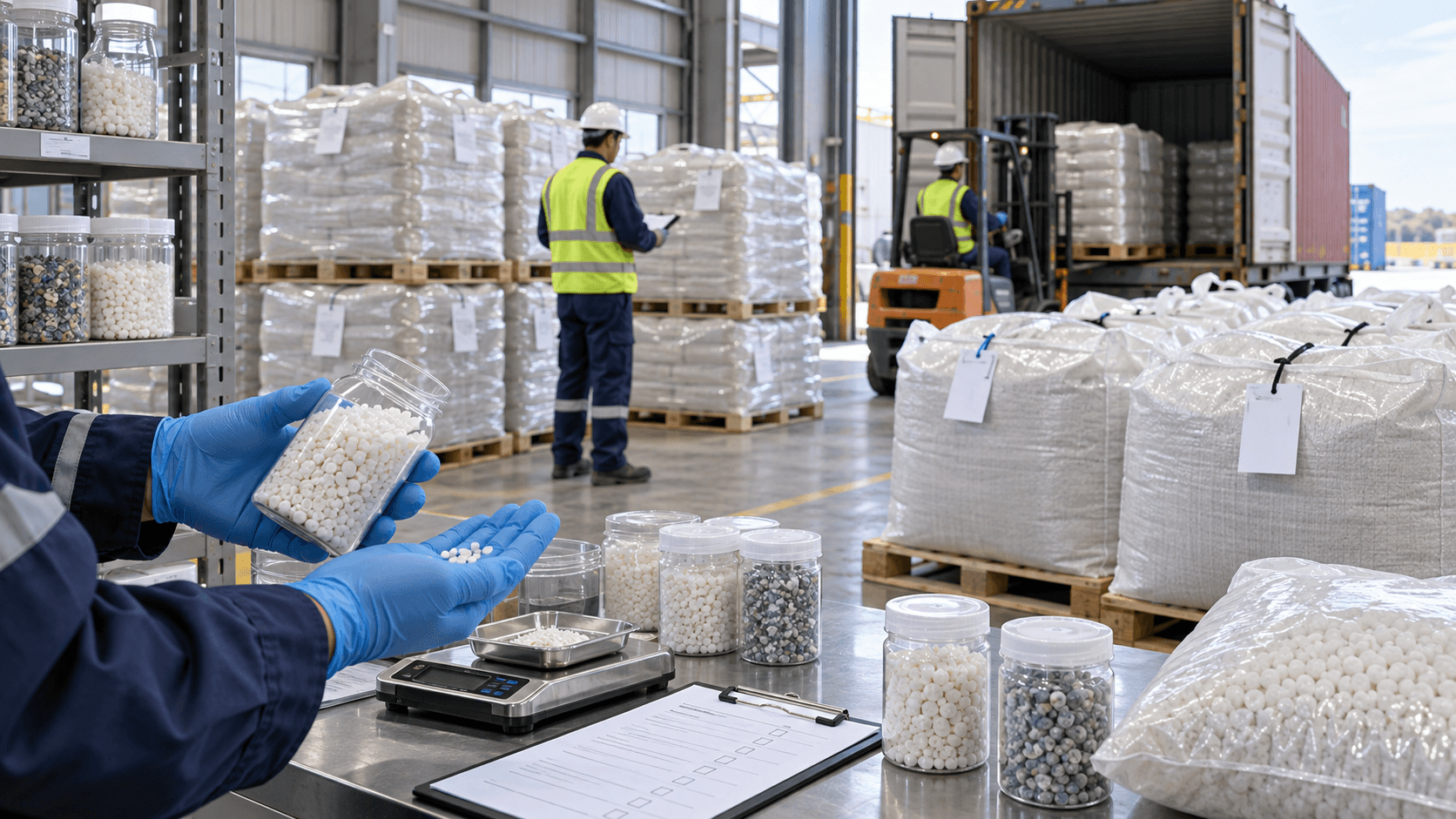
9. Plan the Shipment Inspection
Shipment inspection should connect the physical goods to the purchase order and approved lots before the container doors close.
Product and quantity
- Verify grade name, lot codes and bag labels.
- Count bags or pallets and confirm the net-weight basis.
- Match lots to the COA and packing list.
- Photograph representative labels and pallet arrangement.
Packaging
- Inspect seams, liners, closures and visible damage.
- Confirm pallets and wrapping are suitable for the transport plan.
- Keep bags dry and protected from dust or other cargo.
- Confirm any required pallet treatment or shipping marks.
Container
- Check that the container is clean, dry and free from strong odour or visible damage.
- Inspect floor, walls, roof and door seals before loading.
- Use a loading pattern that avoids unstable stacks and excessive bag pressure.
- Record container and seal numbers in the shipment file.
Sampling
Follow the agreed sampling plan. Samples should identify the lot and point or package from which they were taken. Seal pre-shipment retained samples before loading and store them under conditions that protect their relevance.
An inspection company can verify visible conditions and documents, but it cannot guarantee processing performance unless the scope includes representative sampling and agreed laboratory tests.
10. Control Documents Before Departure
Prepare a document checklist early. Depending on the transaction, it may include commercial invoice, packing list, bill of lading instructions, certificate of analysis, safety data sheet, certificate of origin and customer-specific declarations.
Names, weights, package counts and product descriptions should be consistent across documents. Resolve discrepancies before departure. A technically correct material can still create delay and storage cost if documentation does not match customs or payment requirements.
11. Incoming Inspection at the Buyer’s Factory
Do not move newly arrived material directly into unrestricted production stock. Use a receiving status until identity and condition are confirmed.
- Check container seal and visible transit condition.
- Compare labels, lots, quantities and documents.
- Inspect bags for moisture, tears, contamination or compression damage.
- Sample according to the agreed plan.
- Compare pellet appearance and key incoming results with the specification and retained sample.
- Run a confirmation trial when the programme requires it.
- Release, quarantine or reject by authorized personnel.
If material appears different, preserve evidence before mixing lots or emptying bags into a silo. Notify the supplier with lot numbers, photographs, test method, results and affected quantity. Clear evidence shortens root-cause analysis.
12. Evaluate Total Supply Risk, Not Only Price
Compare suppliers using a weighted scorecard. Suggested categories include technical fit, lot consistency, testing, traceability, communication, capacity, lead time, export experience, corrective action and commercial terms.
A small price difference can disappear if a shipment causes extra screen changes, colour correction, rejects, line cleaning, sorting or missed delivery. Conversely, paying more does not guarantee quality. The best value is a grade and supply system that stay within the buyer’s accepted window.
Discuss capacity in practical terms. Ask about normal monthly output for the grade, peak-season constraints, raw-material availability, backup equipment and order lead time. A broad company capacity figure may not represent the specific colour or grade required.
Red Flags During Supplier Qualification
- The supplier cannot link the sample to a lot or production route.
- Test results omit the method, temperature, load, specimen or units.
- Every property is promised to be “the same as virgin” without application evidence.
- Product labels, COA and packing list use inconsistent names or lot codes.
- Changes in feedstock, formulation or manufacturing route are not communicated.
- The supplier refuses a reasonable retained-sample or complaint-investigation process.
- Price is quoted before the application and critical requirements are understood.
- Recycled-content claims are broad but supporting definitions and documentation are unclear.
One red flag may be a communication gap that can be corrected. Several together indicate a higher control risk.
Conclusion
Qualifying a recycled polystyrene supplier requires more than collecting a TDS and comparing prices. Define the application, understand the material route, agree test methods, evaluate multiple representative lots, run the real process, retain samples and inspect the shipment before loading and after receipt.
The central principle is traceability: the approved sample, production lot, COA, bag label, pre-shipment sample and incoming result should tell one consistent story. That system gives the buyer and supplier a practical basis for repeat orders and corrective action.
Send Your Material and Order Requirements
Send Cherein your target material, application, current specification, annual or monthly demand, destination port and preferred trial quantity. We can organize a grade discussion, representative sample and export-order checklist for recycled EPS, HIPS, expandable PS or compatible masterbatch.
Frequently Asked Questions
How many recycled-plastic lots should be tested before a container order?
There is no universal number. One lot can show feasibility, while two or more representative lots provide better evidence of repeatability. Increase the qualification depth for appearance-critical, high-volume or safety-related applications.
Is a COA enough to approve recycled PS pellets?
No. A COA should be linked to agreed methods and limits, but the buyer should also review traceability, sample representativeness, factory process, packaging and finished-product performance.
Should I arrange a third-party shipment inspection?
It can be useful for quantity, packaging, labels, container condition and witnessed sampling. Define the scope carefully because a visual inspection alone does not prove processing performance.
What should be retained after approval?
Keep the agreed specification, TDS, COA, supplier lot information, sealed resin sample, trial settings, test results and approved finished parts. The supplier should retain a corresponding batch sample where practical.
How should a supplier change be controlled?
Agree which changes require notice, such as formulation, feedstock route, key raw material, manufacturing location or process. Review the change and repeat relevant testing before normal release.